EXPANSIÓN ha preguntado a sus lectores cuál creen que ha sido el mejor despacho de abogados en 2010. A continuación viene la lista y se puede ver como van las votaciones. ¿adivinan quien va ganando?

«Nulla dies sine linea»
jueves, 2 de diciembre de 2010


Los cartelistas impenitentes
Según Connors/Helmers, estas 11 empresas son las cartelistas reincidentes.
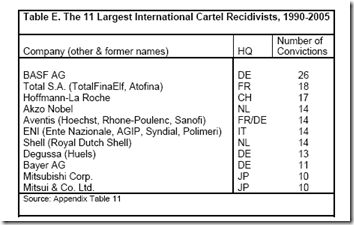
Algunas deducciones

Algunas deducciones
- no hay ninguna empresa norteamericana entre las mayores reincidentes, lo que sin duda, se debe a que es el único país, hasta esa fecha, en la que los cartelistas iban a la cárcel. Moraleja: la disuasión se logra con la amenaza de la cárcel. Poner multas de cuantía estratosférica perjudica a los accionistas de esas compañías y a sus acreedores y no beneficia a los consumidores.
- incluye datos hasta 2005, de manera que no refleja los efectos disuasorios del reforzamiento de la lucha europea contra los cárteles donde la puesta en práctica del programa de clemencia (2002 pero sobre todo, 2006) y el aumento brutal de las multas ha tenido que tener efectos.
- Hay un predominio abrumador de empresas alemanas/suizas y japonesas lo que, sin duda, tiene algo que ver con la cultura empresarial de esos países (la invasión norteamericana tras la segunda guerra mundial incluyó la “descartelización” de Alemania “Desnazificación, descartelización, desmilitarización y democratización eran las piedras angulares que pusieron los aliados para cambiar Alemania”) pero, lo más significativo para explicar por qué participan en tantos cárteles será, no obstante, la estructura de mercado y el tipo de producto que fabrican o distribuyen.
- que haya cartelistas que reinciden no permite extraer conclusiones rápidas sobre la eficacia o no de la política antimonopolio. Esperemos a que Connor actualice estos datos incluyendo el período 2005 a 2010 para ver cómo cambia la lista. Mi apuesta es que (i) seguirán sin aparecer empresas norteamericanas y (ii) ninguna – o casi ninguna - de esas empresas aparecerá como reincidente en un mayor número de casos de los que aparecen en esa lista.
La LSRL 1953
Gracias a un lector del blog y antiguo alumno, aquí está la Ley de sociedades de responsabilidad limitada de 1953
Informe McKinsey-Fedea sobre el “modelo productivo”
En general, muy sensato (bastante más que los informes del Gobierno que dieron lugar a la Ley de Economía Sostenible). Lo ha publicado 5Días. Algunos apuntes. Uno, creo que subestiman el potencial de la industria española de comida y bebida. España podría convertirse en un gran exportador de productos de calidad de comida y bebida y ponerse al nivel de Italia. Por dos razones (las de siempre). Tenemos una demanda muy exigente en este ámbito, lo que ha obligado a las empresas nacionales a “espabilar” para satisfacerla. Los españoles nos gastamos mucho dinero en comer y beber fuera y dentro de casa. España dispone, además, de una variedad y calidad de materias primas incomparable. Y la segunda es que el sector de la distribución de productos de consumo es muy competitivo y está forzando a los fabricantes de productos de consumo a mejorar la calidad y relación con el precio. Probablemente hay que gastarse más en marketing. Pero si Zara, Mango o Springfield han conseguido abrir miles de tiendas para vender ropa por todo el mundo…
Me parece acertada la observación acerca de la necesidad de aumentar el tamaño de nuestras pymes. Más difícil es saber qué medidas podrían tomarse para inducir procesos de concentración. Un problema español es, sin duda, el de que tenemos demasiados “chiringuitos” en todos los ámbitos. También – como recordó Valentín Fuster – en el ámbito de la investigación. Small is beatiful pero, a menudo, muy ineficiente. Por ejemplo, la Comunidad de Madrid está promoviendo centros de excelencia en investigación – IMDEA – que no van a alcanzar la masa crítica suficiente para dejar huella como think tanks. Concentrar los esfuerzos parece imprescindible. Debería comenzarse, en todo caso, por recopilar y analizar la información. Es decir, saber quién está haciendo qué en toda España y, a partir de ahí, las empresas de capital de riesgo o las fundaciones dedicadas a esa actividad podrían orientar sus inversiones a financiar, no a las microempresas sino a las que resultan de la concentración de esfuerzos separados. El Informe dice que hay que fomentar la “concentración de esfuerzos públicos en torno a un número más reducido de centros de innovación o en temas más delimitados”. Ni el Estado ni las CCAA deberían financiar proyectos de cuantía inferior, por ejemplo, a los 250.000 euros. Las convocatorias de proyectos de los Ministerios de Educación y de las Comunidades Autónomas en el ámbito universitario (mejora de la calidad docente, proyectos de investigación, financiación de la movilidad del profesorado…) son proyectos de cuantías individuales ridículas cuya gestión es muy costosa en personal y cuyos resultados no se han medido – que yo sepa – . ¿Por qué no concentrar todo el dinero en unos pocos proyectos cada año y repartir por vía no competitiva las miserables ayudas para estas actividades a los profesores?
También parece correcto centrar el tiro en los servicios empresariales. Siempre me acuerdo de que la filial española de Arthur Andersen era una de las mayores del mundo y que, desde España, se atendía a buena parte del Mediterráneo y África. Es obvio que, en el ámbito de servicios de consultoría, asesoramiento jurídico, técnico etc, América es un mercado de enorme potencial. Y estas grandes consultoras ofrecen formación a nuestros jóvenes y les permiten viajar. ¡Nunca se ponderará bastante el bien que ha hecho el programa Erasmus! España tiene, tras Gran Bretaña, los despachos de abogados más grandes en proporción al tamaño de su economía. La Ley de Acceso es un error ya que eleva las barreras de entrada a la profesión y, por tanto, reduce la competencia.
Y la relación entre turismo y atractivo de las ciudades españolas para vivir está, también, en “la onda” (Florida pero ver esto). Pero no creo que el problema sea el de la facilidad o dificultad para abrir una empresa (para constituir una sociedad, en realidad) que es lo que mide el Informe del Banco Mundial.
Creo que fomentar la cultura emprendedora es muy difícil (reducir la aversión al riesgo y el miedo al fracaso etc) y que quizá bastaría con aumentar los incentivos para trabajar mandando un mensaje claro, por parte de los poderes públicos, de que el que no trabaja, no come y que los loros que comen chocolate del presupuesto público son una especie a extinguir. Este es, a mi juicio, el principal problema español. Si aumentan los incentivos para trabajar, aumentará, al menos proporcionalmente, el número de emprendedores.
Por último, ¿por qué no se incrementa, de un plumazo, la oferta de plazas en Medicina? Si nuestros jóvenes con vocación científica quieren estudiar medicina y no sobran científicos en España, debería obligarse a todas las Facultades de Medicina de España a incrementar en un 25 % su oferta de plazas de primer año. Es un ultraje que jóvenes con un expediente de sobresaliente en bachillerato y selectividad no consigan una plaza. Ya.
El expediente por abuso de posición dominante contra Google
Según la Comisión Europea, estas son las acusaciones contra Google
- lowering the ranking of unpaid search results of competing services which are specialised in providing users with specific online content such as price comparisons (so-called vertical search services) and- by according preferential placement to the results of its own vertical search services in order to shut out competing services. The Commission will also look into allegations that Google- lowered the 'Quality Score' for sponsored links of competing vertical search services. The Quality Score is one of the factors that determine the price paid to Google by advertisers (The Quality Score influences the likelihood of an ad to be displayed by Google and its ranking. If two advertisers are using the same key words, the site which has a lower Quality Score will have to offer a higher price to rank at the same place).- The Commission's probe will additionally focus on allegations that Google imposes exclusivity obligations on advertising partners, preventing them from placing certain types of competing ads on their web sites, as well as on computer and software vendors, with the aim of shutting out competing search tools. Finally, it will investigate- suspected restrictions on the portability of online advertising campaign data to competing online advertising platforms.
A bote pronto, parece que la Comisión Europea trata de concentrarse en las eventuales conductas excluyentes y no en conductas explotadoras. Es decir, en conductas que podrían ayudar a Google a reforzar su posición en el mercado – o a extender temporalmente su fuerte posición – dificultando el acceso al mercado de competidores. Algunas de las descritas son conductas que consisten en aprovechar la posición en un mercado para defenderse frente a la entrada en mercados relacionados con aquél – el de búsqueda en Internet – en el que la empresa tiene la posición de dominio.
miércoles, 1 de diciembre de 2010
Multas y revisión judicial en Derecho europeo de la competencia
Damien Gerard ha publicado un breve trabajo sobre este tema. Recogemos los pasos más interesantes
At the end, what is at stake is nothing less than the legitimacy of the EU antitrust enforcement system, which is conditioned on effective judicial review. Moreover, the recent trends are all the more worrisome in a context of continuous increase in the amount of fines and in view of statistical indicia of a decline in the intensity of the judicial review process.
Indeed, “the [Court of Justice] has jurisdiction in two respects over actions contesting Commission decisions imposing fines on undertakings for infringement of the competition rules. First, under Article [263 TFEU], it has the task of reviewing the legality of those decisions. ... Secondly, [it] has power to assess, in the exercise of the unlimited jurisdiction accorded to it by Article [261 TFEU] and Article [31 of Regulation 1/2003], the appropriateness of the amounts of fines”.
Pursuant to Articles 261 TFEU and 31 of Regulation 1/2003, the Court of Justice is endowed with unlimited jurisdiction to assess the appropriateness of, and if necessary to vary,downward or upward, the amount of the fine imposed by the Commission. However, in view of the system of division of powers set out by the EU Treaties, “the [Union] judicature is not competent ... to replace the fine imposed by the Commission by a new, legally distinct fine” but only “to rule on fines set by decisions of the Commission”.
The scope of the unlimited jurisdiction with respect to fines is also constrained by the fact that it does not form an autonomous course of action, listed in Article 256 TFEU; rather, it is ancillary to the power to review the legality of Commission decisions pursuant to Article 263 TFEU. Accordingly, its “sole effect” is to “enlarge the extent of the powers the [Union] judicature has in the context of the action referred to in Article [263 TFEU]” so that it is not limited to annulment of a Commission decision but can also “vary the penalty imposed by that decision”.12 Likewise, it does not entitle applicants to seek the annulment of a Commission decision for grounds other than those listed in Article 263 TFEU. In the words of the GC: “an action in which the [Union] judicature is asked to exercise its unlimited jurisdiction with respect to a decision imposing a penalty necessarily comprises or includes a request for the annulment, in whole or in part, of that decision”.13 In “Vitamins”, the GC further emphasized that “the review which the Court is required to exercise in respect of a Commission decision finding an infringement of Article [101 TFEU] ... and imposing fines is confined to a review of the legality of that decision”. This implies that the Court of Justice may exercise its unlimited jurisdiction “only where it has made a finding of illegality affecting the decision, of which the undertaking concerned has complained in its action, and in order to remedy the consequences which that illegality has for determination of the amount of the fine imposed, by annulling or adjusting that fine if necessary”. In the same case, it reiterated that, where the Commission’s decision is vitiated by an illegality, “the Court must exercise its unlimited jurisdiction in order to confirm, set aside or adjust” the fine.
Consider first the “Electrical and Mechanical Carbon and Graphite Products” case and, specifically, the plea alleging the illegality of Article 15(2) of Regulation 17, as reproduced in Article 23(2) of Regulation 1/2003. One of the applicants submitted that the provision granted the Commission almost unlimited discretion as regards the setting of fines and was thus in breach of the principle of legality, as set out in Article 7(1) of the European Convention for the Protection of Human Rights and Fundamental Freedoms (ECHR).21 A classic claim, indeed, which led to interesting counterarguments on the part of the General Court, including the following assertion: “under Article [261 TFEU] and [Article 31 of Regulation 1/2003], [the GC and the ECJ] have unlimited jurisdiction in advance brought against decisions whereby the Commission has fixed fines and may thus not only annul the decisions taken by the Commission but also cancel, reduce or increase the fines imposed”, adding that “[t]hus, the Commission’s administrative practice is subject to unlimited review by the [Union] judicature”. The position of the GC in that case testifies of a particularly broad interpretation of the unlimited jurisdiction with respect to fines. In essence, it embodies a controversy as to whether the unlimited jurisdiction pertains to the “decisions imposing fines” or to the “amount of the fines” only.In Danone, first, the ECJ implied that the GC was entitled to vary the fine on the basis of Article 261 TFEU, independently of a finding of error of law, i.e., that Art. 261 TFEU constitutes an independent ground of action. But the Prym judgment appears more problematic. While dismissing an argument to the effect that the GC had failed to properly assess the legal consequences to be drawn from the infringement by the Commission of its obligation to state reasons with respect to the actual impact of the infringement on the market, i.e., to annul the decision or reduce the amount of the fine, the ECJ held that “the unlimited jurisdiction conferred on the [General Court] by Article 31 of Regulation No 1/2003 in accordance with Article [261 TFEU] authorises that court to vary the contested measure, even without annulling it, by taking into account all of the factual circumstances, so as to amend, for example, the amount of the fine” (emphasis added). Even if the language is softer, it is reminiscent of the GC’s stance in “Electrical and Mechanical Carbon and Graphite Products”: the whole “contested measure” can be varied pursuant to Article 31 of Regulation 1/2003 – even in the absence of any illegality? – and not exclusively the “amount of the fine”.If one wishes to move towards a system where the decisions of the Commission imposing fines are subject to the unlimited review of the Court of Justice, it would require amending the EU Treaties, in particular Articles 264 and 266 TFEU
Suscribirse a:
Entradas (Atom)